
What's the Difference Between a Caregiver and a CNA?
Your mom is scheduled for a hip replacement at Mission Hospital, and the doctor said she’s going to need a lot of help when she returns home — more than you’ll be able to manage on your own. Your research says the typical in-home options are either a CNA or a caregiver — or maybe a nurse aide? But what’s the difference, really? And which one will your mom need?
Pursuing either choice means different things for the process you will go through, how the costs will be covered, and what kind of care your mom will receive. Let’s try to simplify things.
What is a CNA (or Nurse Aide)?
CNA stands for certified nursing assistant, someone trained in providing clinical support services under the supervision of a licensed nurse or physician. CNAs are not licensed, but they have earned certification through an accredited training program approved by the state and are typically registered with a state department or board.
Most states use the term CNA. In North Carolina, however, the role of CNA is split in two and given the names nurse aide I and nurse aide II, or NA I and NA II. The Department of Health Services Regulation, or DHSR, oversees NA I training and registration. The North Carolina Board of Nursing, NCBON, oversees NA II training and registration.
The specifics of each role are not as important as knowing when you need or can get help from a nurse aide. Because a nurse aide works under the supervision of a licensed provider, they can only provide in-home care as part of a written care plan signed by that provider — especially if you plan to use health insurance or Medicare to pay for it.
Nurse aides can monitor vitals, care for wounds, assist with range-of-motion exercises, and help with medical equipment. Personal care like bathing, grooming, and feeding can be part of a care plan if they are provided in addition to medically necessary services.
A care plan targets a specific medical condition and usually has an end point, so we’re not talking about ongoing, regular care. Medicare.gov has a useful summary of what is and is not covered. Private insurance coverage may differ, but in general insurance will expect that any services rendered by a nurse aide are related to the specifics of the care plan.
What is a Professional In-Home Caregiver?
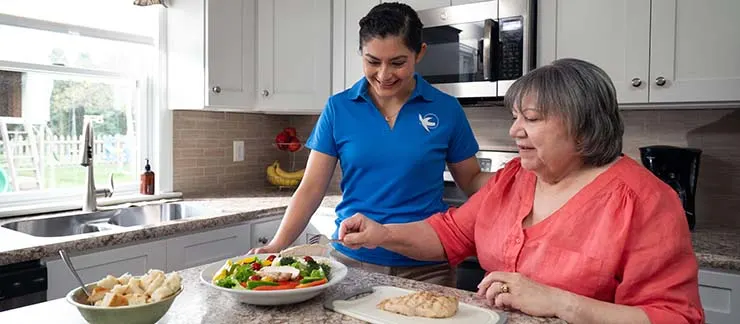
A professional in-home caregiver provides non-medical assistance with tasks of daily living. At Visiting Angels Asheville, we call these personal care and companion care, and they include assistance with bathing, hygiene, meal prep, running errands, medication reminders, and light housekeeping as well as playing games, respite care, or just being good company.
In-home care providers are still overseen by the State of North Carolina. They must be licensed by the Department of Health and Human Services (DHHS), specifically under DHSR, or certified by an organization approved by DHHS. There are four official levels of care which each require their own qualifications. You can always ask a provider to tell you what they’re certified for.
The primary difference from a CNA or nurse aide is that there does not need to be a medical condition or a care plan. That has implications for your insurance. Most people will pay out of pocket, though long-term care insurance can be helpful here. However, some in-home services can qualify as medically necessary and thus be tax deductible.
CNA/Nurse Aide vs. Caregiver at a Glance
CNA/Nurse Aide | In-Home Caregiver | |
Certification | DHSR or NCBON | Agency licensed by DHR |
Care provided | Clinical support for a medical condition | Activities of daily living, companionship, transportation |
Supervision | Licensed nurse or physician | Licensed agency |
Funding | Insurance, Medicare | Typically private pay or long-term care insurance |
Does Your Elderly Parent Need a CNA or a Caregiver?
For most Asheville-area families, deciding between a CNA/nurse aide or a professional in-home caregiver comes down to whether there’s a specific medical condition or not.
Seek a nurse aide for support recovering from a surgery or with monitoring vitals or IV management at home. If your family member needs an injection as part of their care, that’s a job for an NA II. Speak with your loved one’s physician about getting a written care plan and arranging for in-home services from a nurse aide.
Choose an in-home caregiver to fill in the gaps of daily tasks so a senior can continue to live independently. It could be an extra hand getting in or out of the shower or getting a lift to the store or the Grove Street Community Center.
Many older adults will use both a nurse aide and a caregiver at some point in their lives — skilled in-home care in the weeks following a hospitalization, then transitioning to ongoing personal care.
Getting the Right Care
Visiting Angels Asheville is a licensed, non-medical in-home care provider serving Asheville, Weaverville, Hendersonville, and more. Unsure if Dad needs a nurse aide or a professional caregiver? Give us a call and a care coordinator can talk you through the decision, assess your needs, and help you understand the best care fit for your loved one.